


Textile Sensor
Product Details:
- Thermal Conductivity Standard
- Surface Finish Coated
- Capacity High Sensitivity
- Part Type Sensor
- Noise Level Low
- Automation Grade Automatic
- Size Standard
- Click to View more
X
Textile Sensor Price And Quantity
- IP54
- Contactless (Photoelectric/Proximity)
- White Body with Black/Red Front
- Relay Output
- 0°C to 60°C
- 12-24V DC
- Thread Break/Presence Detection in Textile Industry
- Wired
- < 1 ms
Textile Sensor Product Specifications
- Approx. 2-3 cm (Sensor head)
- Fixed
- About 50 g
- Durable, Precise Detection
- Standard
- Automatic
- Approx. 5 x 2 x 2 cm
- Sensor Component
- Textile Sensor
- Low
- Coated
- High Sensitivity
- Sensor
- Metal and Plastic
- Standard
- Yarn/Cotton Break Detection
- Up to 12000 rpm
- Suitable for various textile machines
- IP54
- Contactless (Photoelectric/Proximity)
- White Body with Black/Red Front
- Relay Output
- 0°C to 60°C
- 12-24V DC
- Thread Break/Presence Detection in Textile Industry
- Wired
- < 1 ms
Product Description
Having core coordination with clients, we are engaged in supplying them an excellent quality Textile Sensor. The offered sensor is manufactured using top quality raw materials as per the quality standard norms. The provided sensor is capable of capturing comprehensive physiologic data from the body and are designed to be seamlessly integrated into everyday garments. In addition, the offered Textile Sensor can be bought from us at market leading prices by our valued clients.
key Points:
- Longer functional life
- High performance
- Easy maintenance
- Reliable operations
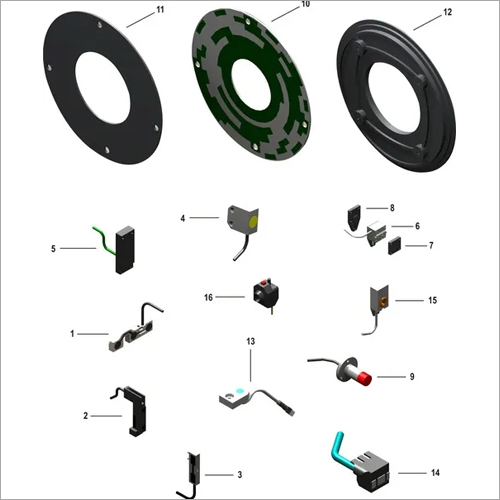
| ID: | TK No: | ART No: | Designation: |
| 1 | TK2902 | 845029000 | PFR Sensor D1 |
| 1 | TK2903 | 845031000 | PFR Sensor D2 |
| 2 | TK2904 | 911328097 | Projectile Sensor |
| 3 | TK2905 | 911321058 | Flight Trigger |
| 4 | TK2906 | 927009861 | Su Sensor |
| 5 | TK2907 | 911802333 | Angle Sensor |
| 5 | TK2920 | 911180684 | Angle Sensor no cable |
| 6 | TK2908 | 911321038 | Sensing Head |
| 6 | TK2901 | Sensing Head with steel pieces HD | |
| 7 | TK2918 | Front steel piece | |
| 8 | TK2919 | Rear steel piece | |
| 9 | TK2909 | 930202669 | Sensor for motor let off |
| 10 | TK2910 | 911603018 | Angle disc PU D93 |
| 11 | TK2915 | 911303768 | Angle disc D130 |
| 12 | TK2917 | Angle disc D130 P7100 | |
| 13 | TK2911 | 911325019 | Sensing head D1 |
| 13 | TK2912 | 911328098 | Sensing head D2 |
| 14 | TK2913 | 911302192 | Holding Magnet |
| 15 | TK2914 | 911321062 | Feeler Head |
| 16 | TK2916 | Contact piece |
Precise Contactless Thread Detection
The sensors advanced photoelectric/proximity technology enables highly accurate, contactless thread break and presence detection. This is essential for maintaining seamless textile operations and reducing manual intervention, thus bolstering overall productivity and product quality in fabric manufacturing environments.
Rugged Construction with Efficient Performance
Made with a blend of coated metal and plastic, the sensor is engineered for durability and resilience. Operating smoothly between 0C and 60C, it features low noise levels, high sensitivity, and a compact form ideal for fixed mounting on standard textile machines, even in demanding industrial settings.
FAQs of Textile Sensor:
Q: How does the textile sensor detect thread breakage without physical contact?
A: The textile sensor utilizes photoelectric or proximity detection technology to sense the presence or absence of yarn and cotton threads without touching them. It promptly triggers a relay output signal when a thread break occurs, allowing for fast, automatic machine responses.Q: What are the benefits of using this sensor in textile machines?
A: Employing this sensor enhances production reliability by providing precise, contactless detection of thread breaks or presence. Its rapid response time (less than 1 ms) and high sensitivity help minimize downtime, reduce waste, and support consistent fabric quality.Q: When should the sensor be installed on a textile machine?
A: The sensor should be installed during machine setup or retrofitting, particularly when automating thread monitoring is required. It is suitable for high-speed environmentsup to 12,000 rpmwhere manual inspection is impractical.Q: Where can this textile sensor be equipped in the production process?
A: This sensor can be mounted in any position where thread or yarn integrity needs verification, such as spinning, weaving, or winding points on various textile machinery. Its standard size and wired connection facilitate integration into existing setups.Q: What is the installation process for this sensor?
A: Installation involves securely fixing the sensor at a designated spot using its fixed mounting type. It should be connected to the machines relay interface and powered by 1224V DC, ensuring the sensors head (approx. 23 cm diameter) faces the monitored thread path.Q: Can the sensor withstand high dust or moisture levels?
A: With an IP54 protection class, the sensor resists dust infiltration and water splashes, making it suitable for typical textile factory environments. However, it should not be submerged or exposed to heavy jets of water.Q: How is the sensor maintained for optimal use?
A: Regularly inspect the sensor for surface buildup and verify firm mounting. Keep electrical connections secure and operate within temperature (0C to 60C) and voltage limits to maximize its lifespan and maintain detection accuracy.Tell us about your requirement

Price:
Quantity
Select Unit
- 50
- 100
- 200
- 250
- 500
- 1000+
Additional detail
Mobile number
Email


Contact Details
APOLLO IMPEX
GST : 19ACNPC6788J1ZV
GST : 19ACNPC6788J1ZV

- 4, Synagogue Street, 8th Floor, Kolkata - 700001, West Bengal, India
- Phone : 08045813832

- Mr Sachin Chandak (Proprietor)
- Mobile :08045813832
- Send Inquiry
 Send Inquiry
|


APOLLO IMPEX
All Rights Reserved.(Terms of Use)
Developed and Managed by Infocom Network Private Limited.
Developed and Managed by Infocom Network Private Limited.

